
Most AI rollouts don’t stall because the model underperforms. They stall because the people meant to use it quietly decide not to. Budget approval doesn’t close that gap leadership does.
In my previous article, Leadership Mindset for AI Transformation, I argued that the hard part of AI is rarely the technology. This piece goes deeper into one shift: moving people from resistance to adoption. Having led right-sizing programmes, culture change and operating-model transformations in banking across four continents, I’ve found that resistance is rarely about the tool. It is about what people believe the tool means for them.
Short on time? Here’s the short version.
- Why people resist: fear of job loss, loss of expertise and status, distrust of black-box tools, change fatigue, and tools handed down rather than shaped. The pushback is usually rational — a signal to read, not a morale problem to manage.
- What leaders get wrong: treating adoption as a training problem, announcing instead of involving, measuring usage instead of outcomes, and not using the tools themselves.
- Build trust first through governance: explainability, human-in-the-loop review and clear accountability make AI easier to trust — and therefore easier to use.
- The 5-step AI change management framework: clarify the why, involve frontline teams, start low-risk and high-visibility, build champions (starting with yourself), and measure and share wins.
Why Employees Resist AI — and Why It’s Usually Rational
AI resistance rarely looks like open rebellion. It looks like a tool that gets logged into twice and then ignored, or a team that keeps running the old process in parallel “just to be safe.”
Fear of job loss. Even when no roles are at risk, employees read the silence. When nobody says what the AI is for, people assume the worst.
Having led several right-sizing programmes at global banks, I learned that silence does more damage than difficult news. People can plan around a hard answer; they cannot plan around no answer.
Loss of expertise and status. A credit analyst with fifteen years of judgment is now asked to defer to a system that learned from data. That can feel like being told their experience no longer counts.
When I led the consolidation of a global bank’s lending operations across more than 10 Latin American countries, the hardest conversations were with country experts whose processes — and standing — were being replaced by a regional model. What turned it around was making them the designers of the regional standard, not its recipients. Their judgment didn’t disappear; it became the template.
Distrust of black-box tools. If a recommendation can’t be explained, people won’t stake their name on it — especially in regulated work.
Change fatigue. Teams that have lived through several “transformations” treat the next one as something to wait out.
Tools handed down, not shaped. Software built without its users fits the process on paper, not the process in practice.
None of this is irrational. In an Indeed survey of more than 2,000 job seekers published in January 2026, 35% named AI adoption as their top concern for the year — ahead of burnout. Leading AI transformation means addressing legitimate concerns, not overcoming bad attitudes.
What Leaders Get Wrong About AI Adoption
Employees’ concerns are only half the story. Four common leadership patterns make those fears worse.
- Treating adoption as a training problem. Training answers “how do I use this?” Employees are asking “why should I, and what happens to me if I do?”
- Announcing instead of involving. A launch email tells people a decision has been made. It doesn’t give them a stake in it.
- Measuring usage instead of outcomes. High login counts with unchanged cycle times is compliance, not adoption.
- Leaders not using the tools themselves. If executives never touch the system, teams conclude it isn’t important enough to change how they work.
Governance Builds Trust — and Trust Drives Adoption
Governance is often framed as a brake on adoption. In practice it is one of the strongest accelerators, because people trust what they can inspect.
- Explainability — users can see why a system produced an output, not just that it did.
- Human-in-the-loop review — a named person makes the final call on consequential decisions, protecting both the customer and the employee’s sense of professional ownership.
- Clear accountability — agreed in advance who is responsible when the AI is wrong, so nobody is left wondering whether they will be blamed.
Systems built alongside domain experts, rather than around them, are also far easier for those experts to accept. I saw the same pattern while building a financial crime compliance culture at a global bank: controls held when people understood why they existed, not just what they required.
At our fintech partner iDigiCloud, that principle shaped its AI-based Early Warning System for non-performing loans. It doesn’t just flag accounts at risk — it shows why. The banker still makes the call, but with the reasoning in front of them and their own judgment intact.
The practical test is simple: could an employee explain to a customer or regulator why the system did what it did? If not, you are asking people to carry risk they cannot see.
A Five-Step AI Change Management Framework
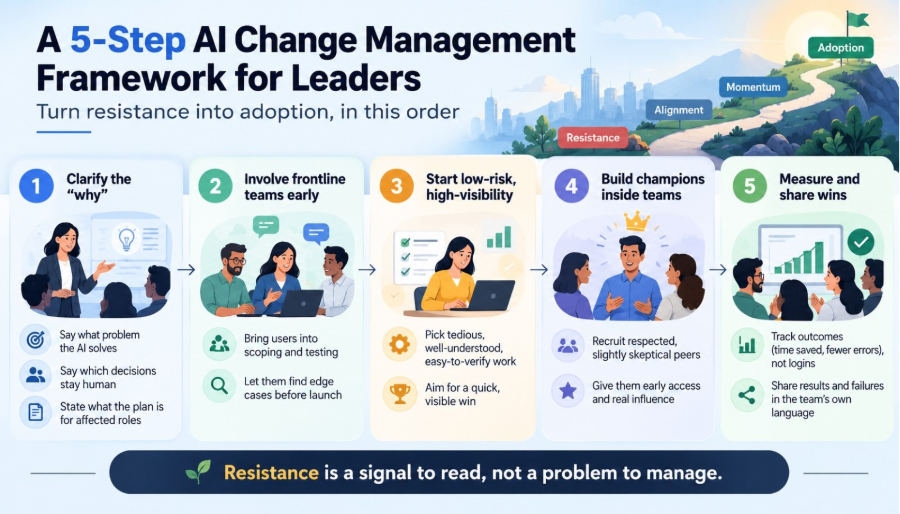
A good framework doesn’t need to be elaborate. Five steps cover most of what matters, and the order matters as much as the steps.
1. Clarify the “why” — and what won’t change
Say plainly what problem the AI addresses, which decisions stay human, and what the plan is for affected roles. Specific commitments land better than reassurance.
Addresses: fear of job loss.
2. Involve frontline teams early
Bring the people who do the work into scoping and testing. They will find the edge cases the vendor demo missed, and they rarely oppose what they helped shape.
Addresses: tools handed down, and loss of expertise.
3. Start low-risk, high-visibility
Pick work that is tedious, well understood and easy to verify, such as summarising documents or drafting routine responses. A quick, visible win builds more credibility than an ambitious pilot that takes a year.
Addresses: change fatigue.
Our partner Samta.ai built an AI solution for a cybersecurity firm in Latin America, moving from discovery to a proof of concept, and only then into the team’s daily tools. Each phase had to work before the next began.
4. Build champions — starting with yourself
Peers persuade better than executives, but executives set the signal. Use the tools visibly yourself, and share your own prompts, mistakes included. Then give respected, slightly sceptical people early access and real influence over how the tool evolves, and let them speak honestly about its limits.
Addresses: loss of status, and the message leaders send by staying on the sidelines.
5. Measure and share wins
Track outcomes the team cares about, such as time saved or fewer errors, rather than logins. Share them in the team’s own language, failures included.
Addresses: change fatigue, and the gap between usage and real adoption.
This takes sustained attention, not a one-time launch. At PeopleDynamiX, this is where we spend most of our time: running the people side of AI change alongside the client’s own teams, with managed digital transformation support from our technology partner Samta.ai where needed — so momentum doesn’t fade after launch, and the client’s people stay focused on day-to-day delivery.
Frequently Asked Questions
What is AI adoption?
AI adoption is when people use AI tools in their daily work and the organisation sees measurable results. Buying or deploying the technology is not adoption.
How can leadership better support AI adoption?
Explain the purpose and limits of the AI, involve frontline teams before launch, use the tools visibly yourself, and measure outcomes rather than logins.
Why do employees resist AI?
Usually for sound reasons: job security, loss of professional standing, distrust of systems they can’t inspect, and fatigue from repeated change.
Should AI use be mandated?
Mandates force minimum usage, not genuine adoption. Pair clear expectations with real involvement and visible benefit, so use grows because the tool is useful.
Next Step
Pick one AI initiative already under way and test it against the five steps above. Find the first gap and fix that one first, with an owner and a ninety-day goal.
For an independent view, PeopleDynamiX offers a 2–3 week diagnostic of your people capabilities, AI and data readiness, and regulatory posture. Start the conversation at info@ppldynamix.com or www.ppldynamix.com.