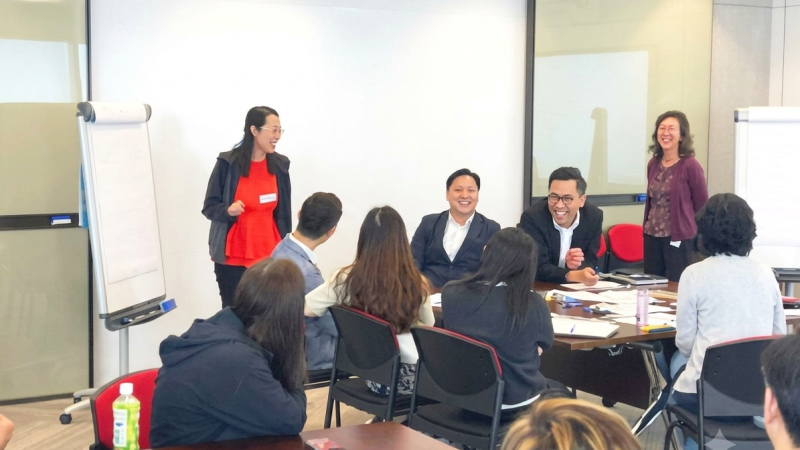
By Jaideep Nikam, CEO, PeopleDynamiX
Most enterprises have spent money on AI — models licensed, platforms procured, pilots launched. Yet many stall before the business changes how it operates. The problem is rarely the technology; it is how leaders frame problems, decide, assign ownership and prepare people.
I’ve spent two decades leading banking transformations across Asia, Europe, North America and South America. Today I design AI-based banking products for fintech companies and work with banks and financial institutions on shifting leadership mindset. The lesson hasn’t changed: tools can be bought easily, but alignment, culture, governance and accountability take sustained leadership attention.
Seven Mistakes I Keep Seeing
- Starting with the tool, not the problem — no outcome, so no way to judge success.
- Too many pilots, no path to production — talent spent, no capability built.
- Every function building its own AI — duplicated spend, data nobody can reuse.
- Dismissing employee anxiety — low adoption, quiet workarounds.
- Bolting governance on at the end — slower delivery, higher risk.
- Treating AI as an IT project — everyone involved, no one accountable.
- Measuring launches, not outcomes — activity reported, value unproven.
Each is a mindset problem. Here are the seven shifts that fix them.
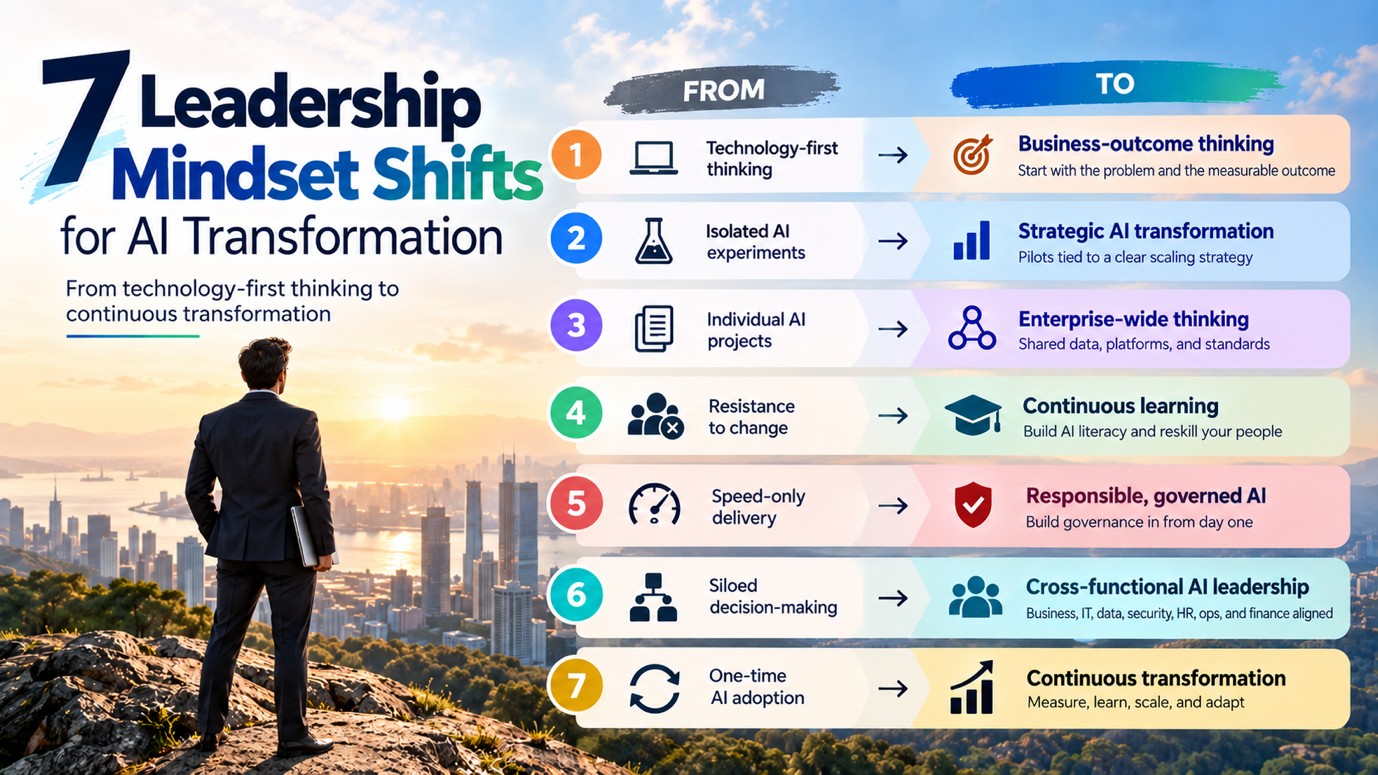
The Seven Shifts
1. From technology-first to business-outcome thinking
Start with a measurable business problem, then ask whether AI is the right lever. Test: state the initiative in one sentence without naming a technology. “Reduce loan decision turnaround while keeping decisions explainable” is an outcome. “Deploy a large language model” is not.
Our Fintech partner iDigiCloud designed a tool that helps Indian banks estimate their RBI data quality (sDQI) score. The brief never began with “use AI” — it began with “know your score early enough to fix it.” Whether each component needed machine learning or simple rules was decided only after that.
2. From isolated experiments to strategic AI transformation
Each pilot should answer a specific question, with criteria to scale, redesign or stop. Strategy sits above the pilots: a few prioritised initiatives funded to production beat a portfolio of disconnected experiments.
3. From individual projects to enterprise-wide thinking
AI ignores departmental boundaries. Treat shared data, platforms and risk standards as strategic assets — and fix data readiness first.
A regional transformation I led for a global bank in Latin America consolidated fragmented country operations into one model, saving tens of millions of dollars because leadership insisted on one shared view. Most enterprises are about to recreate that fragmentation with AI. I’ve seen organisations where marketing, collections and fraud each build their own AI on the same customer data — so one model offers a customer a credit-limit increase while another flags them as a collections risk.
4. From resistance to continuous learning
Employees rarely resist technology. They worry about job security, opaque measurement and being left behind. Make readiness a core workstream: build AI literacy at every level, be honest about how roles will change, fund reskilling, and involve frontline staff in redesigning their own workflows.
When PeopleDynamiX designed a leading bank’s digitalisation strategy, technology was the easy part. As transactions moved online, branches became places for advice — and the real barrier was reluctance to learn. For staff who had mastered transactions, a new role felt like giving up the expertise that defined them.
5. From speed-only to responsible, governed AI
Speed without control creates risk that surfaces later and costs more to fix. Design governance in from the first use case.
Our technology partner Samta.ai (https://samta.ai/services/ai-security-compliance), built a fraud and AML platform for a US bank in short agile sprints. The key was the definition of “done”: every new detection capability shipped with its explanation logic and audit trail. Speed came from small increments; responsibility came from never deferring governance to a later sprint.
6. From siloed decisions to cross-functional leadership
Business, IT, data, security, compliance, HR, operations and finance each hold a piece. Misaligned, they stall projects in handoffs. The fix: a standing forum with decision rights, a shared roadmap and one accountable executive.
We have seen a bank’s IT team build a well-engineered AI assistant for contact-centre agents — only for legal to block its scripted answers, and agents to ignore it because their KPIs still measured call time, not resolution. No single team failed. The handoffs did.
7. From one-time adoption to continuous transformation
Deployment is the beginning. Models drift, data changes, regulations evolve. Track AI performance and business outcomes together, scale what works and retire what doesn’t.
Fifteen years ago, leading a regional transformation in Latin America, we introduced a fixed release rhythm — minor every 90 days, major every 180 — with a funnel deciding what got in. I’d apply it to AI today. Tools change; good disciplines carry forward.
Where Are You Stuck?
Read each line honestly. Every one that describes your organisation today is a shift your leadership hasn’t yet made.
| Shift | You’re still stuck if… |
|---|---|
| Business outcomes | You can’t name the metric your biggest AI initiative is meant to move. |
| Strategy | Your pilots have no agreed criteria to scale or stop. |
| Enterprise view | Two departments are building AI on the same data without talking. |
| Continuous learning | AI training stops at the technology team. |
| Responsible AI | Risk and compliance first see an AI system just before go-live. |
| Cross-functional leadership | No single executive is accountable for AI outcomes. |
| Continuous transformation | No one checks whether live models still deliver what they did at launch. |
Next Step
Pick the line that would cost you most if left unfixed, assign an owner, and set a ninety-day goal. You don’t need to start from zero — much of what AI transformation demands is discipline your organisation has built before.
For an independent view, PeopleDynamiX offers a 2–3 week diagnostic of your people capabilities, AI and data readiness, and regulatory posture. Start the conversation at jaideep@ppldynamix.com or www.ppldynamix.com.
About the author: Jaideep Nikam is CEO of PeopleDynamiX. He is also Fractional Chief Product Officer at iDigiCloud Technologies and a board member of Samta.ai.