
Two organisations deploy the same AI platform in the same quarter. A year later, one has embedded it into daily work. The other has a handful of enthusiasts and a lot of unused licences.
The gap is rarely technical. It comes down to culture, how people feel about AI, how leaders talk about it, and whether the organisation has made it safe to change how work gets done.
Having spent 25 years in banking and financial services across four continents, the pattern is consistent: organisations that succeed with AI invest in the technology and the people. The ones that struggle invest in the technology alone.
Short on time? Here’s the short version.
| Why culture and AI are inseparable: Technology changes what gets decided and who is accountable. Those are cultural shifts. Ignore them and even the best tools stall. |
| What adoption means: Not that the tool exists — but that people use it, trust it enough to act on it, and know when to question it. |
| Five factors that decide outcomes: Leadership signals, trust, identity and fear, tolerance for experimentation, and incentives. |
| Common mistakes: Treating training as a one-time event, measuring deployments instead of outcomes, skipping middle managers, leaving governance for later. |
Why AI and Organisational Culture Are Inseparable
AI changes how decisions are made, who is accountable, and which skills the organisation values. These are not technical shifts — they are cultural ones. When ignored, familiar patterns appear: tools launch without a story, leaders endorse AI but do not use it, fear goes underground, and incentives still reward the old way.
None of these are solved by a better model. They are solved by leadership, communication, and the design of work itself.
What AI Adoption Actually Means
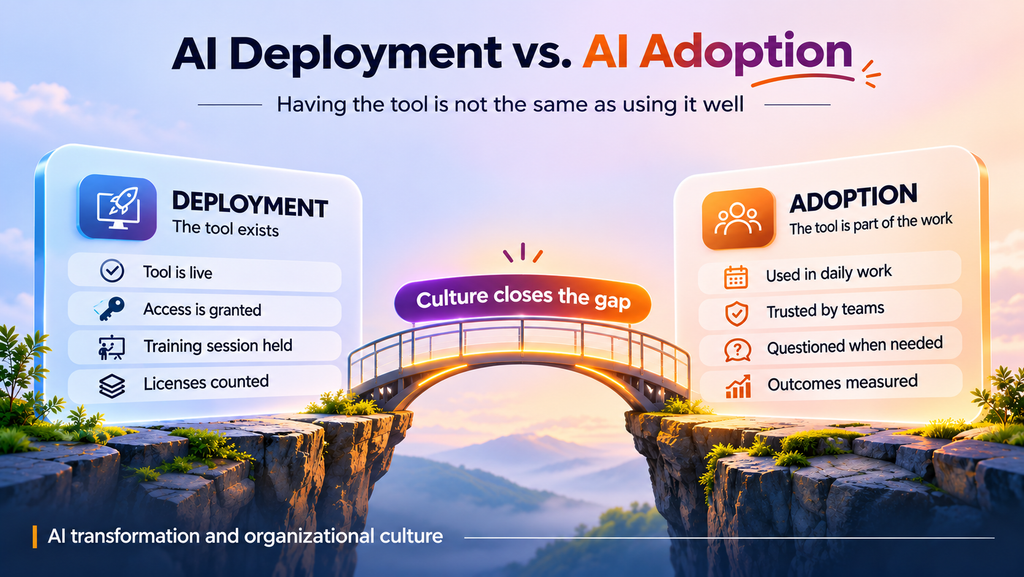
Adoption is when AI becomes a routine, trusted part of how people work — and produces outcomes the organisation can measure. That is different from deployment, which just means the tool exists and people have access.
I saw this recently with a risk team given an AI summarisation tool. Every analyst was still rereading the full file out of habit. The tool was live. It was not adopted. The business case never materialised — not because the AI was wrong, but because nobody had addressed why the team should trust it.
Most organisations track deployment and assume adoption follows. The distance between the two is almost entirely cultural.
Five Cultural Factors That Decide the Outcome
1. Leadership signals
What leaders use, ask about, and reward shapes behaviour more than any announcement. When executives use AI tools in their own work and talk honestly about what works — and what does not — teams follow.
2. Trust
People need to believe the outputs are reasonable, that data is handled responsibly, and that the organisation will be honest about how AI affects their roles.
When we were building a financial crime compliance culture at a global bank, the controls that held were the ones people understood not just what they required, but why. AI governance works exactly the same way.
3. Identity and fear
Many professionals tie their sense of value to expertise that AI appears to automate. Dismissing that concern kills adoption. Addressing it directly — being clear about what remains human judgment — builds credibility.
Our technology partner iDigiCloud built their AI Early Warning System on this principle: it flags portfolio stress signals 30 to 60 days before a default materialises — but does not decide what happens next. The relationship manager still owns that call, now with more time and better information. When people can see that boundary clearly, adoption follows. Fear lives in ambiguity; clarity removes it.
4. Tolerance for experimentation
AI work involves trial and error. If mistakes are punished, people stop trying. Psychological safety around AI experimentation is not a soft initiative , it is a business requirement.
5. Incentives and silos
Collaboration across data, technology, and business teams does not happen by default. When teams are measured in isolation, the highest-value AI use cases the ones that cross functions — never get off the ground.
A Practical Sequence
Five habits, applied consistently, cover most of what matters.
- Tell a clear story — and repeat it.
Explain what problem AI addresses, which decisions stay human, and what the plan is for affected roles. Vague messaging fills quickly with the worst assumptions.
- Make leaders visible users.
Ask executives to use AI in their own work and share what they learn, failures included. That signal travels further than any town hall.
- Start low-risk and high-visibility.
Pick work that is tedious and easy to verify. A quick credible win builds more momentum than an ambitious pilot that takes a year.
- Build champions from within.
Identify respected practitioners who can coach peers. The slightly sceptical early adopter who comes around is more credible than the enthusiast who always was.
- Measure outcomes, not logins.
Track time saved, error reductions, quality improvements. High login counts with unchanged cycle times is compliance, not adoption.
Frequently Asked Questions
1. Why do employees resist AI?
Usually for sound reasons: job security concerns, loss of professional standing, distrust of systems they cannot inspect, and change fatigue. The pushback is almost always rational — a signal to read and address, not a morale problem to manage.
2. Should AI use be mandated?
Mandates force minimum usage, not genuine adoption. Pair clear expectations with real involvement and visible benefit, and use grows because the tool is useful.
3. How do you know if your culture is ready?
Ask whether mistakes get reported or hidden. Ask whether frontline teams helped design how the tools work. Ask whether managers can explain what AI is for in their context. Those answers tell you more than any readiness score.
Next Step
Pick one AI initiative already under way and test it against the five habits above. Find the first gap and fix that one — with a named owner and a ninety-day goal.
Samta.ai’s free AI Readiness Assessment — 20 questions, five minutes — scores your organisation across seven dimensions including Culture, Talent, and Governance, with a personalised roadmap and a consulting call within 24 hours. Take it at samta.ai.
At PeopleDynamiX, we work alongside client teams on the people side of AI change, so momentum does not fade after launch. Start the conversation at info@ppldynamix.com or www.ppldynamix.com.